History of Pythagorean Numerology — 2600 Years of Evolution
When you name a child using numerology, you're tapping into a system refined over twenty-six centuries — from Pythagoras's first lectures in ancient Greece to modern AI-powered software. Let's trace this journey.
Pythagoras and the Core Idea (570-495 BCE)
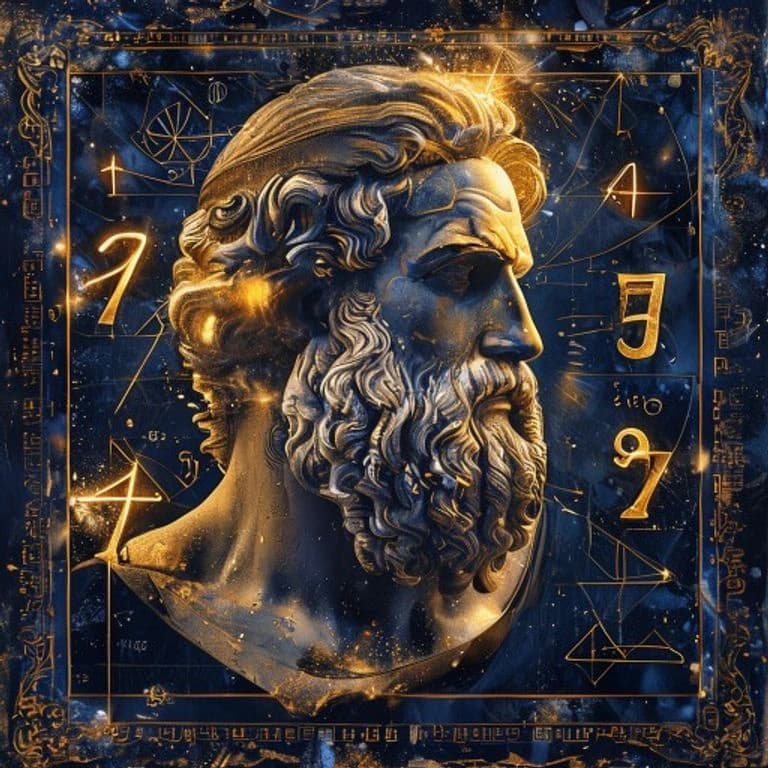
Born on the Aegean island of Samos and later settling in Croton, Southern Italy, Pythagoras is most remembered for his geometric theorem. But for him, mathematics was not merely calculation — it was the language of the universe. His famous saying "All things are numbers" (πάντα ἀριθμοί ἐστιν) became the foundation of an entire philosophical school.
The Pythagorean school believed every number from 1 to 9 carried its own vibrational frequency, and letters — created for communication — carried those same numbers. Writing someone's name doesn't just record sound; it creates a vibrational map.
Decline and Revival (5th BCE – 19th century)
After Pythagoras's death, his numerical system survived orally and was preserved by medieval mystics — especially in Jewish Kabbalah and the Gematria tradition. The original Pythagorean system for the 26-letter Latin alphabet was largely lost from public teaching after Christianity became the Roman state religion in 380 CE.
Renaissance scholars like Henry Cornelius Agrippa (1486-1535) restored the letter-to-number mappings. But "numerology" in the modern sense was truly born in early 20th-century America.
Modern Era: L. Dow Balliett and Juno Jordan
L. Dow Balliett (1847-1929), an American New Thought practitioner, popularized the Pythagorean system through books like The Philosophy of Numbers (1908). She introduced calculating the Life Path number from birth date and Expression number from name — the two pillars MiKiName still uses today.
Her brilliant student Juno Jordan spent 60 years refining the method and published Numerology: The Romance In Your Name (1965). She first proposed the Master Numbers 11, 22, 33 concept with the "don't reduce" rule — visible in every MiKiName report.
Hans Decoz and the Modern Wave
Late 20th century, Hans Decoz (b. 1949) — a Dutch numerologist based in America — refined the system by adding derived indices like Bridge Numbers, Planes of Expression, and built the first computer numerology software. His Numerology: Key to Your Inner Self (with Tom Monte) became the textbook for most contemporary numerologists.
Why 2600 Years Still Matter
Numerology isn't prediction — it's a symbolic framework that helps parents think about their child's name with greater depth. Each name is a decision that influences a child for a lifetime. Numerology gives you a language to discuss that — much like MBTI or Enneagram in psychology.
Pythagoras said: "First prepare the soul, then the soul will shape the life." Naming your child is precisely an act of preparing the soul for the next generation.